Foodizen: When celery was the avocado toast of its day
Jul. ten, 2019


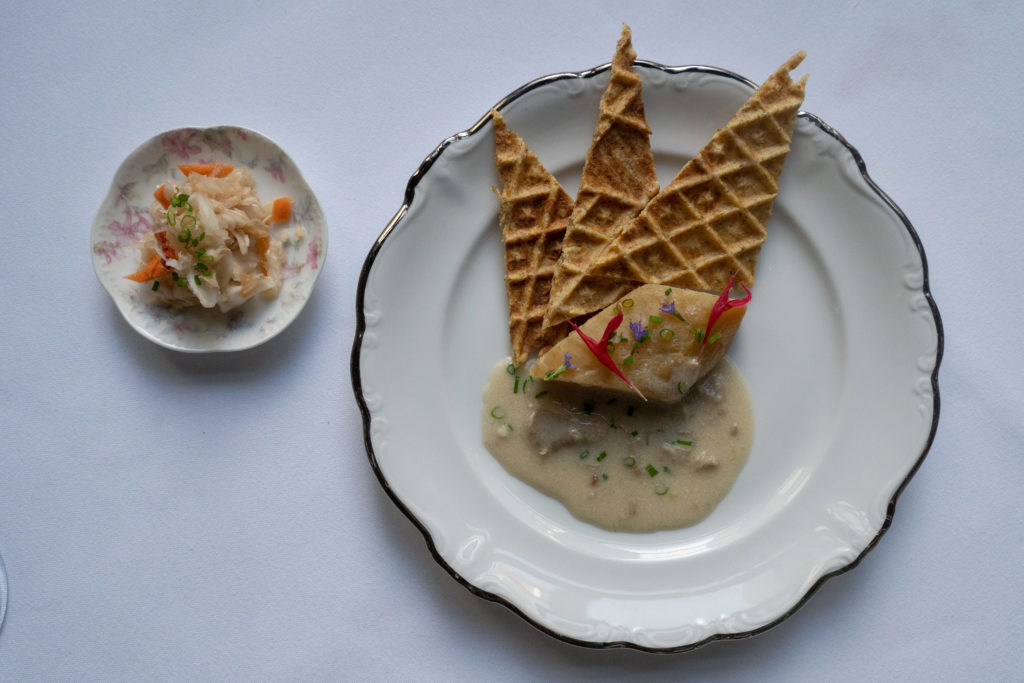
Elwood, tucked under the I-95 overpass at the edge of Fishtown, has one of the strangest and well-nigh essential menus in the city: catfish and waffles, snapper soup, whole frog, and whole rabbit, all served on antique dishware that could have come from a grandma's cathay cabinet. Simply permit me to start with the celery—whole-stem, braised, with Hootenanny and Royer cheeses (both from Pennsylvania). In fact, let me start with the ornate plough-of-the-century celery dish that the celery is served in. Yes, chef-possessor Adam Diltz tells me, at in one case in history, celery was then prized that it required its own dish.

Prefer the audio version of this story? Mind to this article in CitizenCast below:
"During the Victorian era, celery was the hottest dish to eat. It was difficult to grow and so it was a status symbol." says Diltz, who spent three years acquiring the collection of antique silverware, plates, bowls, tureens, and saucers for his restaurant. "Celery dishes were in one case someone'southward prized possession and now no one cares virtually them."
"If yous go to New Orleans, everyone knows what gumbo is. But here, nobody knows what ham pot pie or turtle soup is," Diltz says. "The main question I'm asking is: What if Philadelphia, as a region, hadn't lost its original food culture?"
Who among us can fifty-fifty imagine a time when celery was the avocado toast (or sushi or caviar) of its day? "That's why I exercise that dish," he says. "Plus, I dearest celery and no one else does." If this last fleck is true, that could change after eating Diltz's version channeling the nineteen th century, which merely might brand everyone fall deeply in honey with celery.
It's that mix of deep nutrient-history geekery and brash confidence that makes Elwood ane of the most exciting and of import new restaurants to come along in this urban center in quite some time. Elwood has been described in local food media as serving "Pennsylvania food" or as existence "dedicated to Pennsylvania culinary history," simply that makes it sound way more than slow than it really is.

"It'due south really hard to explain my restaurant," Diltz says. "Most manufactures say it's a Pennsylvania Dutch place. But information technology's not. Information technology'due south not simply that. Or else they think I'one thousand something like City Tavern," he says, referring to the colonial-themed mainstay in Old Metropolis. "Sometimes I telephone call it Pennsylvania Gothic, but my married woman doesn't like that."
Yes, at that place are Pennsylvania Dutch touches, such as ham pot pie, funnel block, and venison scrapple—though that'due south dabbed with harissa ketchup and served spiked on an antler. But the card'south existent energy comes from unearthing and reinventing the kind of food that Philadelphia was famous for when it was one of the about of import cities in the world. We as well often forget that around hither. In the early 19 th century, Philadelphia was the second-largest English-speaking city in the globe, and it had a unique food scene, with a fusion of foreign and local influences, worthy of a global power.
"If you go to New Orleans, anybody knows what gumbo is. Only here, nobody knows what ham pot pie or turtle soup is," Diltz says. "The primary question I'k asking is: What if Philadelphia, as a region, hadn't lost its original food culture?"

Take catfish and waffles. These days, diners likely know chicken and waffles, and they mistakenly know information technology as a "traditional Southern dish" on gastropub menus. Simply chicken and waffles isn't Southern at all. That dish is Pennsylvania Dutch, and it's really a take on what was xix th century Philadelphia's most popular food in which catfish predated chicken. Equally Subconscious Philadelphia reminds u.s.a., "The word Wissahickon is, after all, derived from the Lenape words Wissha mechan , meaning 'catfish creek.'"
"There were inns, run by Germans, serving catfish waffles, all up and down the Schuylkill," Diltz says. People from Centre City made weekend twenty-four hour period trips forth the river to swallow this local effeminateness—at least until the early on 20 th century, when too much pollution in the local waterways killed off the fish and the waffle taverns disappeared.

While historically, the catfish was pan fried, Diltz brines and smokes his catfish, and serves it with cardboard waffles (like to what might take been served at Kugler's a famed 19 th century Philadelphia restaurant) along with pepper hash, which he calls "the sriracha of its day."
Likewise, he cooks his frogs fricassee style, rolling them in cattail pollen, every bit an homage to bullfrog fricassee, a effeminateness of late 18 th century Philadelphia. He serves pork cooked iii ways, family style, with an array of onetime-fashioned sides like mashed potatoes, apple butter, pickled apples, sauerkraut, and rhubarb sauce. The Simpson lettuce is served with pickled quail eggs. Everything is sourced from within 100 miles.
"Food is related to everything in history, and some of that is, frankly, uncomfortable to talk about," Diltz says. "But I desire to talk about it."
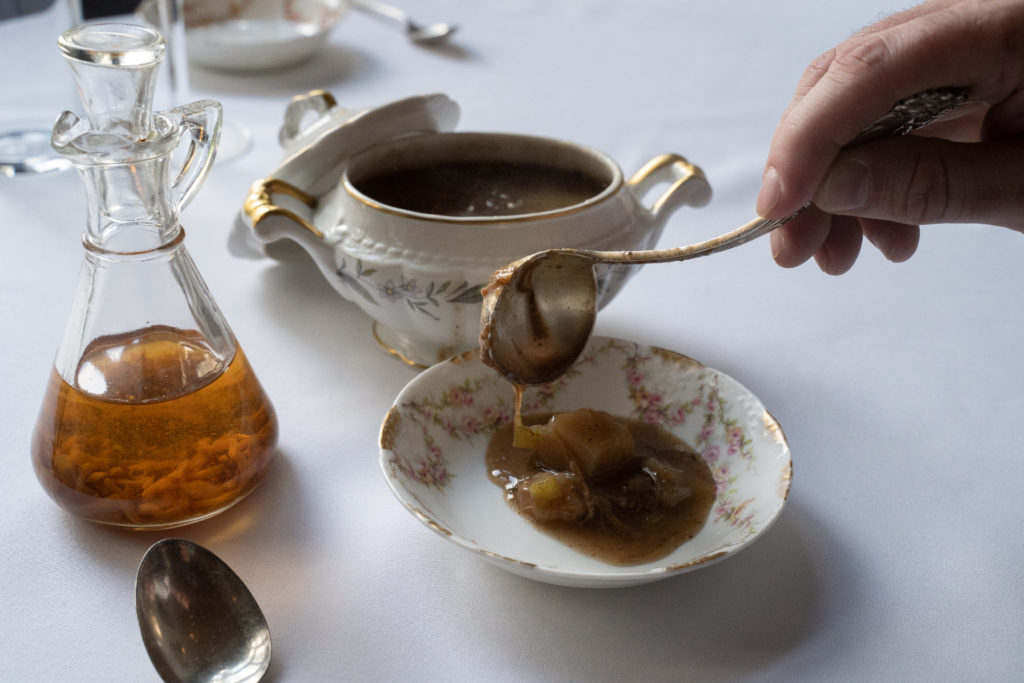
Then, in that location is the Kensington Snapper Soup. Possibly no other dish exemplifies old Philadelphia equally soup made from snapping turtle, a archetype made famous past the celebrated Bookbinder'southward eating place. Every bit Colonel John W. Forney wrote in a book entitled The Epicure in 1879 , "Terrapin is essentially a Philadelphia dish. Baltimore delights in it, Washington eats it, New York knows it; just in Philadelphia it approaches a crime not to be passionately fond of information technology." Travelers throughout the eighteen th and 19 th centuries wrote astonished accounts of huge turtles for auction in the city's markets.
Diltz sources whole 15-pound turtles from New Jersey and Delaware. "It's merely like making chicken soup," he says. "You put them in a pot and simmer it until it's tender." Snapper soup is traditionally served with sherry drizzled on it, and Diltz nods to this by serving Madeira spiked with peppers on the side (Madeira is likely more historically accurate since it was more than bachelor than sherry, whose merchandise was controlled by England).
The catchy attribute of snapper soup, both culinary and historical, is the spices. "The defining characteristic of snapper soup comes from its spices, which arrived hither along with the influx of Haitian refugees in the 1790s afterwards Haiti's slave revolt," Diltz says. Again, information technology might exist difficult to imagine early Philadelphia as a place teeming with international influences, but information technology was. "Caribbean area immigrants sold snapper soup on the streets of Philly," Diltz says.
Though Philadelphia cuisine in the 19 th and early 20 th century was driven past white diners at places like Bookbinder's, Diltz stresses that these dishes owe their popularity to non-white influences. "You cannot accept a eating house serving Pennsylvania cuisine without mentioning Native Americans, the Caribbean influence, or slaves," he says.
He'due south also sensitive to the idea that opening a restaurant based on "Pennsylvania food" has inherent dangers in the current political climate. "I was a little afraid that Trump supporters with MAGA hats would come up in here and say, 'Oh yes, allow's go back to the one-time days,'" he says. That, fortunately, has not happened at all.
"Food is related to everything in history, and some of that is, frankly, uncomfortable to talk about," Diltz says. "But I desire to talk about it." It's this sort of frankness, forth with inspired and meticulous cooking, that makes Elwood a dynamic and succulent identify to eat.
The menu's energy comes from reinventing the kind of food Philadelphia was famous for in the early xix th century, when information technology was the 2d-largest English-speaking city in the globe, and it had a unique food scene, with a fusion of foreign and local influences, worthy of a global ability.
Originally from northeastern Pennsylvania, non far from Scranton, Diltz did not grow up in the kind of family unit that ate at Bookbinder's. "I lived in a trailer, with a unmarried female parent, on food stamps," he says. Elwood is named later on his of his grandfather—"a Methodist who didn't drink, smoke, or swear"—who took him into the forest, and taught him how to chase animals like rabbit.
"I've been thinking nigh this eating place for at least fifteen years," he says. "I'm not Italian. I didn't need to open another Italian eating house. Pasta is not comfort food for me," he says. He's studied the work of pioneering food historian William Woys Weaver and has even enrolled in Weaver'south form at Drexel Academy. "I read Weaver'due south Pennsylvania Dutch Country Cooking when I was notwithstanding in high schoolhouse," he says.
Diltz has been cooking in Philadelphia for many years, honing his arts and crafts at places Farmacia and Johnny Brenda's, all the while imagining and theorizing what Elwood might be. It took him about three years from when the BYO was first announced until it opened its doors in May. The 26-seat dining room, beautifully designed by architect Jenny Ko (Diltz's wife) at the edge of Fishtown'south nightlife hub, is a little oasis in the neighborhood, with 19 thursday century paintings and prints, white tablecloths, and what Diltz calls "one-time-schoolhouse hospitality."
Amidst so much sameness and then many derivative concepts in the restaurant scene, Elwood feels fresh, smart, and—even though the dishes may be centuries old—very much of the moment. It'south the rare restaurant that makes y'all think.
Jason Wilson is The Citizen's 2022 Jeremy Nowak Young man, funded by Spring Point Partners, in award of our late chairman Jeremy Nowak. He is the author of three books, including nearly recentlyGodforsaken Grapes, series editor ofThe Best American Travel Writing, and writes for the Washington Mail, New York Times, New Yorker and many other publications.
Adam Diltz, chef-owner at Elwood. Photo by Anthony Pezzotti 
Source: https://thephiladelphiacitizen.org/foodizen-catfishing-in-philly-irl/
0 Response to "Foodizen: When celery was the avocado toast of its day"
Postar um comentário